


Digital publishing is a good example of an industry that can be improved and automated using many advanced technologies, including push notifications, automation, and artificial intelligence. In this article, we want to focus on the latter technology. How do (and what for) digital publishers use AI? There are five interesting applications.
Last time when we tackled the digital publishing industry, we showed you how digital publishers could monetize their content. Today, we’ll see how they can streamline and speed up work using artificial intelligence.
Today, almost every web analytics tool is supported by artificial intelligence to deliver better, more actionable insights. Suppose you use a web analytics tool (e.g., Google Analytics) on your website. In that case, you have broad access to data about your users/readers, including their interests, characteristics, and traffic sources from which they come to your website.
Such knowledge can be used to create more relevant content that checks your readers’ boxes. Let’s use a simple example: You run a website for future mothers, and your analytics tool tells you that more and more readers come from wedding planning websites. This way, you can create more content on related topics, e.g., how to plan a wedding when pregnant or a list of top wedding dresses for pregnant women.
Accurate audience analysis leads to more relevant content that people visiting your website/magazine expect or want to read. Where is the place for AI here? It can streamline the process of finding relevant topics/questions to tackle and help you create content that’s written in a specific way (AI-powered writing assistants such as Grammarly or Anyword offer such features).
That’s the next step – you have the idea, it’s time to create an actual text. Here, AI can help you by analyzing other texts on a given topic and recommending an appropriate structure, including the title, headlines, and main talking points.
Here, Surfer SEO is a good example. It’s an SEO tool using AI to help you create unique and relevant content. Take a look at how their AI-powered outline builder works (the screen below was generated for an article about consecutive interpretation):
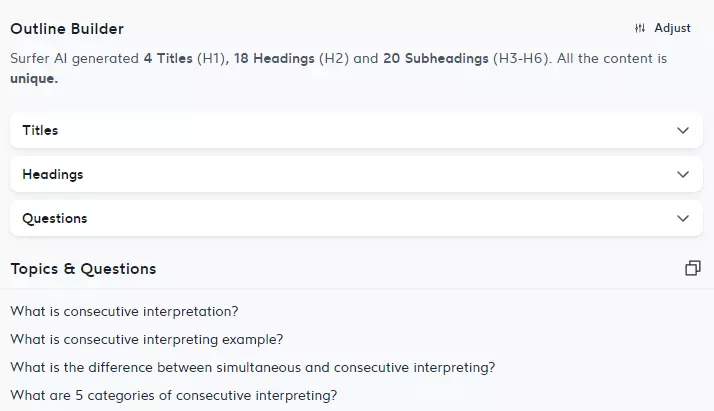
This tool provides content creators with titles, headings, subheadings, questions to answer, and topics to include. Surfer’s AI engine also ensures the recommended outline is unique so that you don’t end up copy-pasting any existing article.
It’s a tremendous help when you struggle with writer’s block. And it helps you create content faster.
How many different reader groups do you have in your company? Whatever the answer, content personalization can help you reach readers more effectively by presenting them with content that’s tailored to their needs and interests. AI uses web data about your readers and provides them with personalized content recommendations. How?
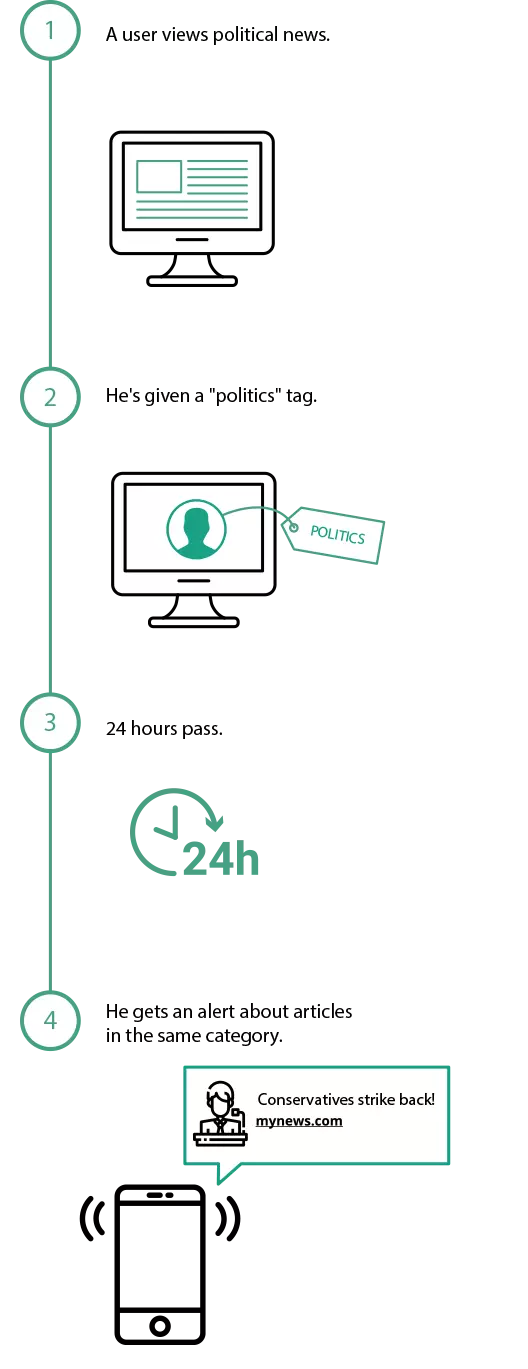
AI tools like PathFactory process all of your content and related metadata. Based on this input, the tool determines what content to show to each site visitor on your website (it’s based on studying the data you have on each user and each post/article). This way, a person interested in winter sports won’t get a recommendation for a rugby-related article.
Content personalization is something we offer here at PushPushGo. When a user subscribes to your web push notifications, our platform tracks their behavior on your website. Each subscriber receives a unique ID tag that allows their identification. Our platform tracks URLs or categories of content visited, clicked content, and the time of the last visit. This input is next used to provide users with personalized content recommendations, just as depicted below:
If you want to reach readers using many different languages you need to translate your content. Here, you have two options:
The second option is more and more advanced thanks to AI. MT tools, such as Google Translate, operate in dozens of different languages. Of course, they are not as accurate and natural as human translators, but they surely can accelerate the content translation process. Here’s an idea that’s worth considering: You can start every translation project using an MT tool and then edit and verify the outcome with a human translator or a proofreader (so-called MTPE – machine translation post-editing). This solution is by no means perfect, but in many instances, you can shorten the time necessary to publish content in many different languages.
When the database of your content consists of hundreds of articles, you need to tag, format, and classify them in order to keep everything organized. Of course, this can be done manually, but AI tools can help you with the process. That’s what the PathFactory we mentioned above does. This tool analyzes all your content and classifies it according to the given piece’s topic and purpose. As a result, everything is well-organized and standardized. Next, such well-labeled content can be used to improve content recommendations.
If you’re wondering why we didn’t mention content creation (namely ChatGPT) in this article, that’s because this service can be useful in less demanding areas (e.g., product descriptions), not in digital content publishing. People want to read content written by human authors, and that’s how we get to the elephant in the room.
AI, at least so far, is not capable of designing completely new, unique content. It needs to have input, something to base on. Therefore, texts generated with AI are not insightful or exploratory; they are just reflections of what has already been published on a given subject.
That said, if you want to create insightful texts supported by real-life experience, you still need human authors. It doesn’t mean, though, that AI is not helpful! As you can see, there are at least five areas in which this technology can be of help.
If you run a digital publishing company, we encourage you to take a look at our solutions for this industry. With our help, you will be able to reach readers more effectively, stay in touch with your subscribers, and provide them with personalized content recommendations.
You can start by registering an account. Our team will help you with the rest!
Editor and writer. She is interested in media and new technologies.
.png)
.png)
-3pf2xltbnb.webp)