



Mobile push allows you to communicate with the users of your mobile app to keep them informed and make them return to your offer more frequently. They're not very different from web push in terms of user-friendliness on both sides of the line.
Mobile push is as old as smartphones themselves. They were introduced in the first iPhone and quickly spread among other devices. Mobile push has proven time and time again to be a simple way of building user loyalty and retention, as well as driving sales.
After a while, the technology was altered to use web push notifications (or desktop push notifications) via websites instead of applications. But that's a wholly different story. If you want to learn more about push notifications, check out one of our other blog posts. This time, we're concentrating on mobile push services in PushPushGo.
Unlike web push notifications, mobile push requires more preparation. Those depend on the technology in which the app is written. In PushPushGo we have a dedicated SDK for mobile push implementation for Flutter, Swift, and Kotlin technologies.
In the process of implementation, the beacons are set up. Those work similarly to web push notification segments, allowing us to track mobile push subscribers and their activities in the application. It's better to have your mobile push strategy thought out beforehand. This is how you'll know what you want to track for your app push notifications and employ the needs to get it.
App users can opt-in to mobile push after they install the application and launch it for the first time. This is when a system prompt appears. There's also a possibility to enable push notifications afterwards, by allowing app notifications in the device settings.
Both Android and iOS operating systems require the app user's opt-in. This is to prevent unwanted mobile push notifications from popping up on the devices. Furthermore, the operating system can also hibernate unused applications.
This means that the apps which weren't used for a given period, won't be able to send mobile push notifications, even if they were previously allowed on the mobile device. This puts an even bigger emphasis on keeping app users in the loop, making them come back to the app as often as possible.
Mobile push subscribers can be tracked based on their activities in the application. This allows you to send them targeted mobile push as well as notifications via automation scenarios.
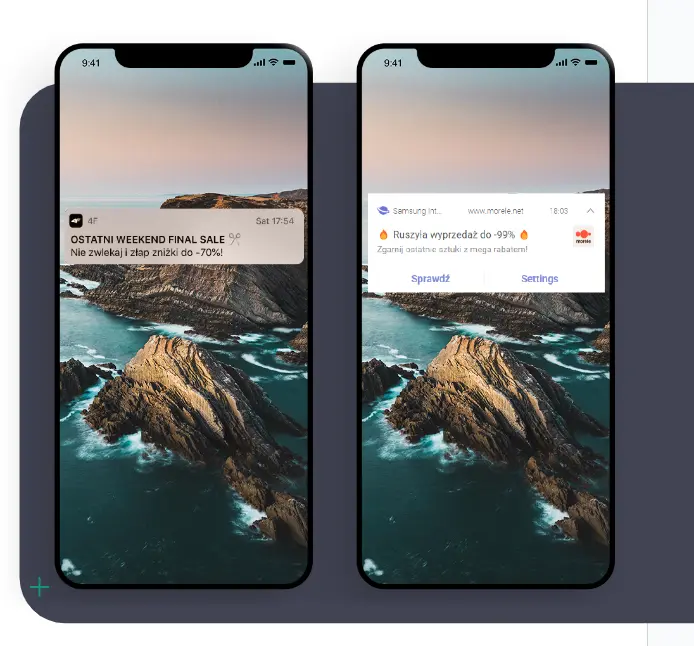
Just as with web push, you can send different types of mobile push notifications. They differ in terms of recipients.
Mass campaigns are the simplest, most straightforward type of push notifications. They are sent to the entire subscriber base. They are also the simplest in terms of preparation. It takes just minutes to send push notifications in the form of a mass campaign. That's why they play a vital role in any push notification strategy.
Mass push notifications can be used to:
In the case of mass push notifications, we advise quality over quantity. The general rule of thumb for both mobile push and web push is to send no more than 4 mass campaigns per month. Additional push messages can be sent as targeted campaigns and automation scenarios.
Targeted campaigns allow you to personalize communication with your app users. Based on information collected via beacons you can address portions of your subscriber base with push notifications better attuned to their interests and expectations.
The targeting can include push notifications advertising specific offers or product categories. For example, if you're running a clothes shop, you may limit mobile push about new skirts to reach app users previously interested in women's fashion. Of course, there are more sophisticated ways to employ targeting:
Targeted push notifications build more personalized communication. This, in time, enhances loyalty, higher return rates, and more conversions.
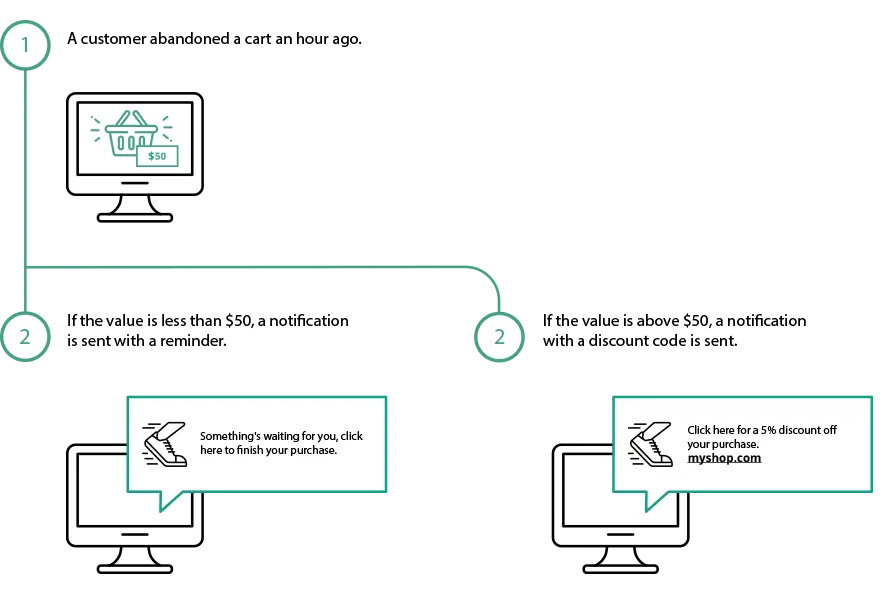
Mobile push notifications can be personalized even further with automation scenarios. Like targeted campaigns mentioned before, scenarios are based on the data collected through beacons. After the initial set up they are sent automatically in response to specific actions taken by the app users.
Automation scenarios provide real-time communication when it's the most important.
Mobile app push notifications provide you with a plethora of options to personalize your communication. This means driving more engaged users which drives more sales and returns to the mobile app. In your mobile push notification strategy, you should make sure you employ all three forms: mass, targeted, and automation.
The size and shape of a mobile app push notifications are directly related to the operating system of a mobile device. It means that their appearance differs between mobile operating systems. However, on a mobile device, all push notifications look the same, no matter which app sends them.
There are still some ways to stand out from the crowd. This is how you can guarantee that your mobile notifications are easily recognizable to your app users.
Action buttons can be added to make mobile push notifications more interactive. Adding up to two additional buttons to a mobile push gives the app users a chance to engage with the notification on their terms. For example, you can show them a product you're promoting, giving them a choice to see it in different color settings. All in one mobile push.
If a lot is going on and many push notifications are being sent in a day, you may want to consider your app users' experience. It can dwindle if mobile users feel like they're being spammed with messages.
It can be prevented if you use mobile push capping. This way you can ensure that your users don't get too many push notifications per day. You can set up a number that suits your needs best.
Mobile push notifications are a must for any mobile application. As mobile users, we can see it for ourselves. The interest in an application falls gradually, the more time passes from the installation. That's why staying in touch is crucial to drive engagement and keep the users informed.
Mobile push notifications work not only in m-commerce. They're useful in any form of mobile app - from stores to services, mobile games, publishers, and more. Anywhere they are mobile users - you want to keep in touch with them.
In PushPushGo, we work with different kinds of companies - varying in size and sectors - helping them to bring out the most from their web and mobile push communication. We help them out with the implementation, creating a push notification strategy, and analyzing the results of their push notification campaigns.
You can see our case study with 4F and see how the cooperation with PushPushGo looks like.
If you want to implement mobile notifications in your service, or you wonder what more can you get from the mobile push, let us know. Contact us at hello@pushpushgo.com. We're sure we can figure something out.
Editor and writer. She is interested in media and new technologies.
.png)
.png)
-3pf2xltbnb.webp)