



Do you like watching, reading, or listening to the news? More and more people don't. People say the news has a negative effect on their mood or that news is untrustworthy or biased. As a result, they avoid the news. This phenomenon is known as news avoidance, and market research shows that this trend is growing rapidly. What can you do to combat news avoidance if you run a news company? We have five solutions you can consider.
Last year, the Reuters Institute, along with the University of Oxford, published a study entitled Digital News Report 2022. While this report is full of practical and valuable data for all digital media companies and professionals, today, we want to focus on just one of its topics – news avoidance.
It’s a phenomenon causing people to stop reading, listening, or watching the news. Sometimes, this phenomenon is referred to as selective news avoidance, meaning some people don’t avoid all news, just those they are not interested in or causing them to feel negative emotions.
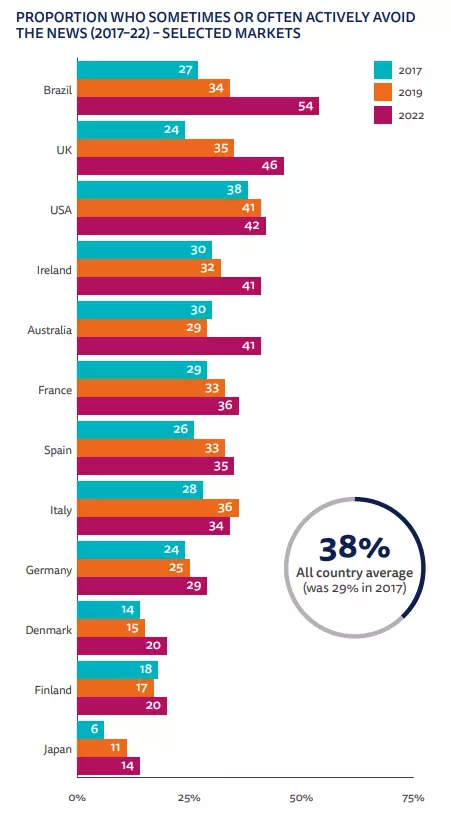
If we take a look at the study conducted by the Reuters Institute, we see that in almost every surveyed country (Italy is the only exception), news avoidance is increasing:
Source: Reuters Institute
Overall, news avoidance in 2022 was at 38%, which is a significant increase from 2017 (29%). The same report shows that this phenomenon is especially common among young adults – under 35 years of age.
The conclusion is obvious – people aren’t compelled to get acquainted with the news, and it’s a global trend – from Japan to the United States. What are the causes behind this situation?
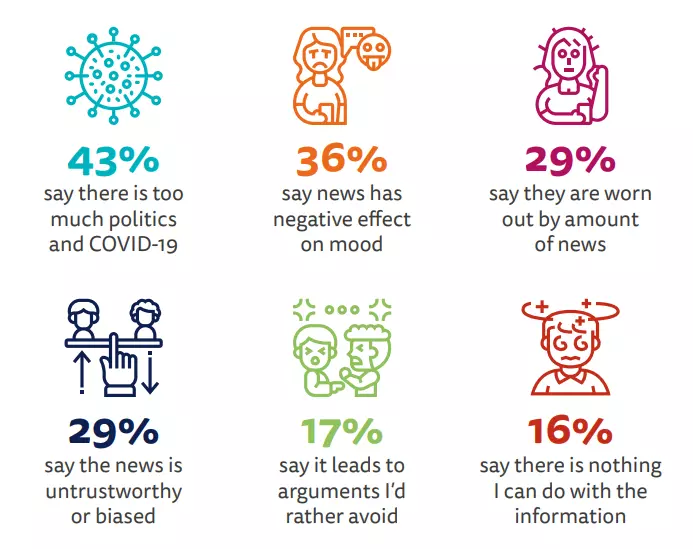
This is a vital question, and the Reuters Institute also decided to ask it. As it happens, there are three major reasons:
Source: Reuters Institute
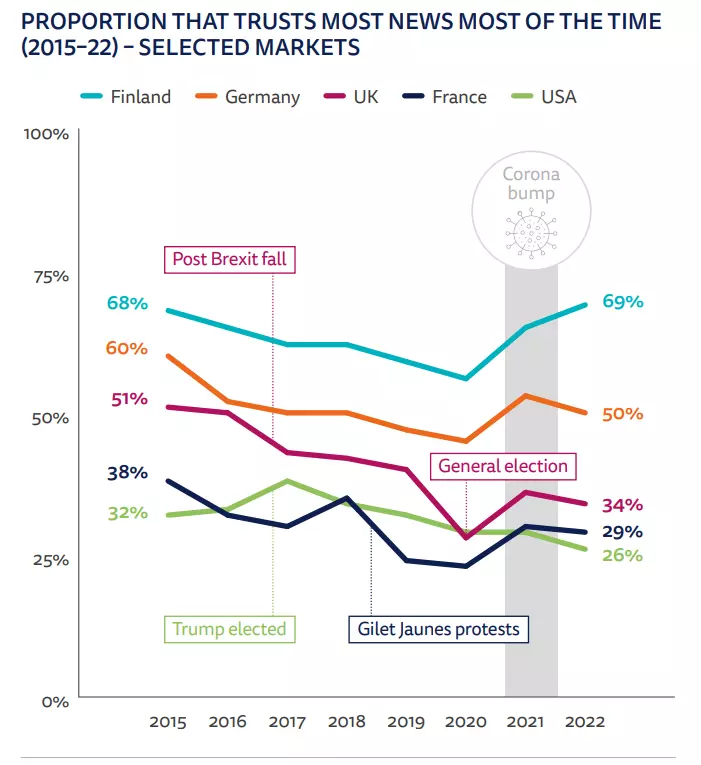
As you can see, almost one-third of respondents said they don’t trust the news they receive. That also seems like a global problem, with Finland being a rare exception (almost 70% of respondents in this country trust the news they receive):
Source: Reuters Institute
Undoubtedly, the problem is both common and severe. It’s especially dangerous to digital media companies and professionals who make their living uncovering, publishing, and distributing news.
If you are such a professional or a company owner, what can you do to combat news avoidance? Let’s have a look.
Since, as Reuter’s report shows, there are several reasons behind news avoidance, there is no one-fits-all solution that can solve this problem on a massive scale. Each company and each professional has to strive to improve their work so that it decreases this negative trend, at least to some extent.
Sure, media broadcast news about wars, conflicts, pandemics, scandals, crime, and natural disasters because these topics are hot; they are frequently shared, commented on, and distributed. And partly, that is what every media organization wants. However, as the cited study shows, there is also the other side of the coin.
We’re not saying here that you should stop publishing news about wars or natural disasters. But try to add something positive to each such piece of news. If you’re writing about natural disasters, make some room to talk about humanitarian aid and relief work. If you write about a conflict, include the voices of people who escaped it and found a safe haven abroad.
Of course, it takes some effort. The positive news is usually harder to find, but the juice is definitely worth the squeeze!
Many people don’t trust the media. You can fight with this approach by publishing only well-researched and verified news. Don’t run every story just because it seems real. Make sure everything you publish is correct and true. Again, this will require some additional work, but as a result, you can reach more news avoiders.
You can even create a special section on your website devoted to the journalistic standards you pursue in your editorial office. Take a look at the example of such a section on CBC Radio – Canada’s national radio station. In the introduction to their journalistic standards, CBC states:
“On issues of controversy, we ensure that divergent views are reflected respectfully, taking into account their relevance to the debate and how widely held these views are. We also ensure that they are represented over a reasonable period of time.”
That’s what high-quality journalism is all about.
This may seem like a bit of bad advice, but many people simply feel overwhelmed by the news they read. There's too much going on, and we have our limits. Be selective when it comes to publishing news. In this industry, quantity has to go hand-in-hand with quality.
You can even try creating a new version of your website/magazine with just the most essential news selected by your editorial staff. Let people choose which version they want to read. After a few weeks, you will be able to assess the popularity of your minimalistic version.
Use your main page, social media channels, push notifications, and newsletters to promote positive news. Of course, such news is slightly less trendy, but this is what many people need – to hear positive news in a world full of violence and disasters. Every time you get a positive piece of news put it in the most visited section of your website. Send out a push notification just about it and post it all over your social media. The result might be better than you expect!
The publishing industry is governed by the same principles and laws as any other. You need to promote your work to keep people interested. Use personalization and geolocation to reach your readers with the news that resonates with them. Never stop looking for new readers (think about introducing performance marketing to your strategy), and implement diverse communication channels to stay in touch with your target audience.
And speaking of diverse communication channels – we encourage you to try push notifications. There are at least four interesting applications of this technology in the publishing industry. We encourage you to get acquainted with them! And if you have any questions or want to start working with us – our team is at your service!
Editor and writer. She is interested in media and new technologies.
.png)
.png)
-3pf2xltbnb.webp)