



What is a good CTR? This is a question that every marketer, whether he wants to or not, asks himself, especially at the beginning of his professional career.
Why? Because CTR, or click-through rate, is one of the most important indicators that you can use to measure performance in online marketing.
CTR is applied to paid advertisements (whether in the Google or Facebook environment), email marketing, web push notifications, landing page or SEO.
CTR (Click Through Rate) is simply the ratio of clicks on an advertisement (notification, newsletter, etc.) to the number of impressions.
For example, if you send a web push notification to 1000 people and 250 of them will click it, the CTR will be 25%.
Conclusion? CTR = engagement.
Here’s the formula by which the clickthrough rate is calculated:
Number of Clicks / Number of Impressions = CTR
CTR is expressed as a percentage (%).
Now let's move on to the answer to the most important question…
Sorry to disappoint you but the truth is that there’s no one-size-fits-all answer.
For every business, a good CTR will be completely different. In fact, individual marketing channels will have different standards for CTR. Sometimes it will be 30% or even 2%.
For example, Google Ads campaigns may have a CTR that is few times lower than Facebook campaigns, but at the same time, potential customers who came to your website from this source may be more interested in your services or products and ultimately convert at a higher rate.
Statistics on average click-through rates may be a reliable reference point. For example, in the case of email marketing, it is between 2.1% and 3.2%, and in the case of web push notifications it is between 5% and 25%.
By comparing your results to these values, you can estimate how effective your campaigns are and, if necessary, take steps to improve your CTR.
CTR is one of the most important marketing indicators. That’s why the first step to increase it should start with making sure that your campaigns are targeted to the right people. Determining who your buyer persona is will help you create personalized messages that achieve better results - for paid ads as well as newsletters or web push notifications.
What makes you click on ads? What brings you to the landing page? Of course, it’s the Call to Action (CTA) button. Make sure that it conveys the purpose of the message in a concise and clear way and encourages to click. Your CTA must stand out! And it's best if it informs about the benefits of going to your site, e.g. "Download for free" or "Learn more".
Of course, you won't learn everything right away, so constant optimization of your actions will allow you to discover effective forms, methods, or even the time of displaying or sending individual ads or messages. Try a few different copies and graphics to find out which style suits your target group best. Most marketing automation systems offer A/B tests as part of their functions, so you can do it without much effort.
CTR has a big impact on search engine rankings, so increasing it is obviously beneficial. The absolute foundation is, of course, the selection of appropriate keywords. Other important factors include the meta title and title description. What counts here is following SEO rules and the ability to convince users - these few lines often have a decisive influence on whether a person clicks on the search result or not.
When creating a marketing persona, it usually turns out that it’s better to use a few of them. Not everyone will like the same service and not everyone will be affected by the same CTA. Track user behavior on the website, research their interests and try to understand their needs. On this basis, divide them into relevant segments. CTR can be much higher when the message is addressed to fewer people. After all, it's not just about the number of impressions, it's about the clicks, isn't it?
CTR is often referred to in the context of email marketing. An interesting alternative to this solution are web push notifications, which allow you to achieve up to 5 times higher CTR.
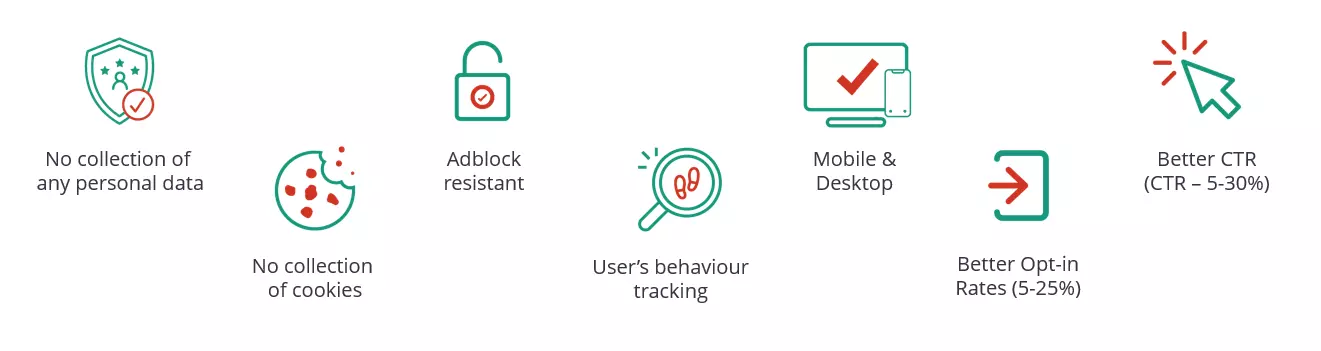
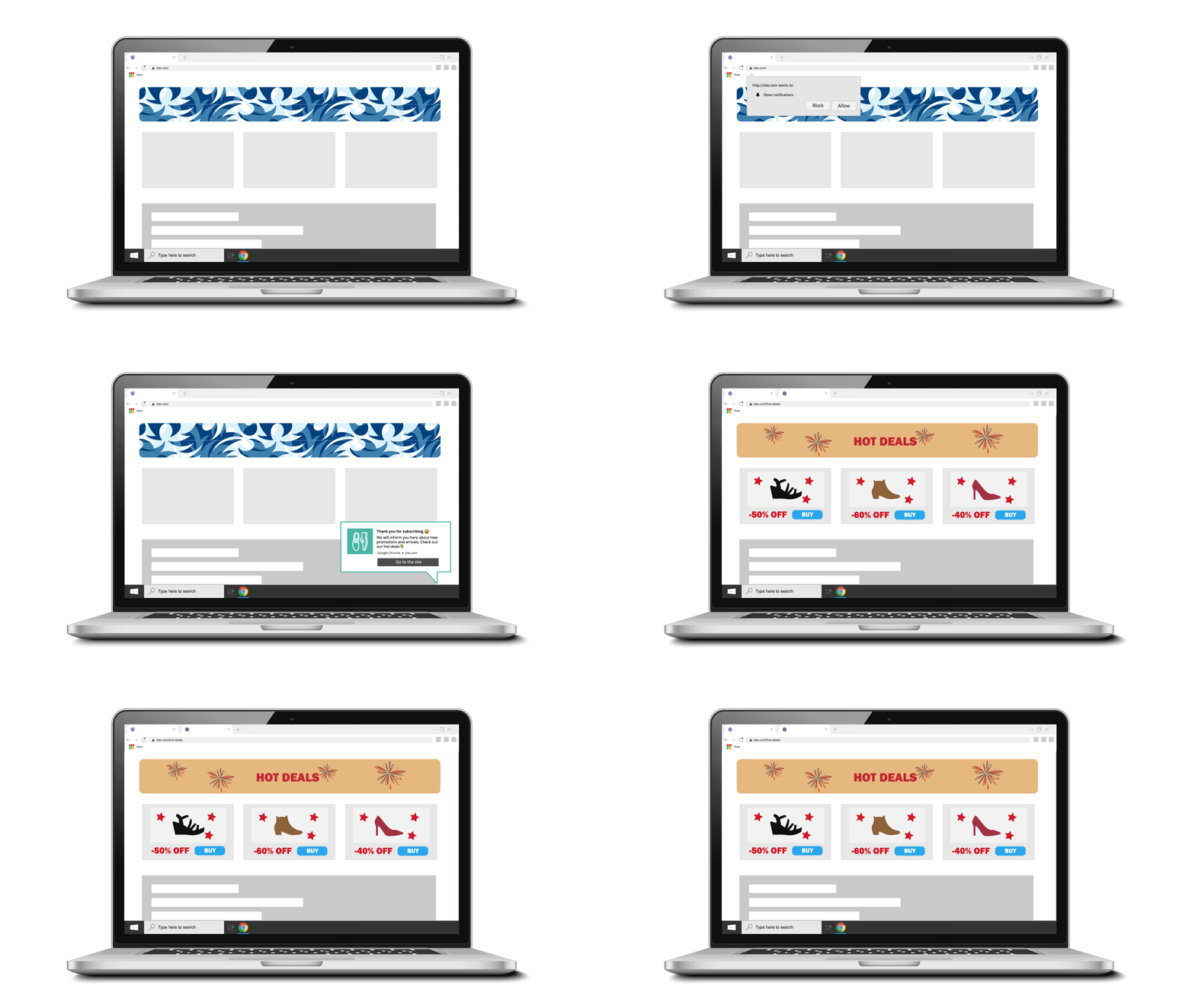
These are small messages that appear directly on user screens - both desktops and mobile. They are sent via web browsers and don't require any personal information to collect.
Of course, most of the ways described above will apply here. The specificity of web push notifications, however, makes it worth taking care of the optimization of several other factors:
Web push notifications work - but only when you're sending them in moderation and delivering user-relevant content through them. If you bombard subscribers with notifications every hour, you can be sure they'll quickly start to ignore them.
Find out: Why is it worth to use web push notifications?
This is particularly important for news portals. Your subscribers want to receive notifications in order to have access to all important news as soon as possible. That's why we've developed the Rocket Push feature, which allows you to create a campaign in less than 60 seconds.
To make sure your subscribers don't receive outdated information, make sure you set an appropriate expiration date.
The option of sending campaigns by taking into account the time-zone is also a very useful feature. This way you can be sure you won't wake anyone up with a discount notification in the middle of the night. Though it may be worth it sometimes...
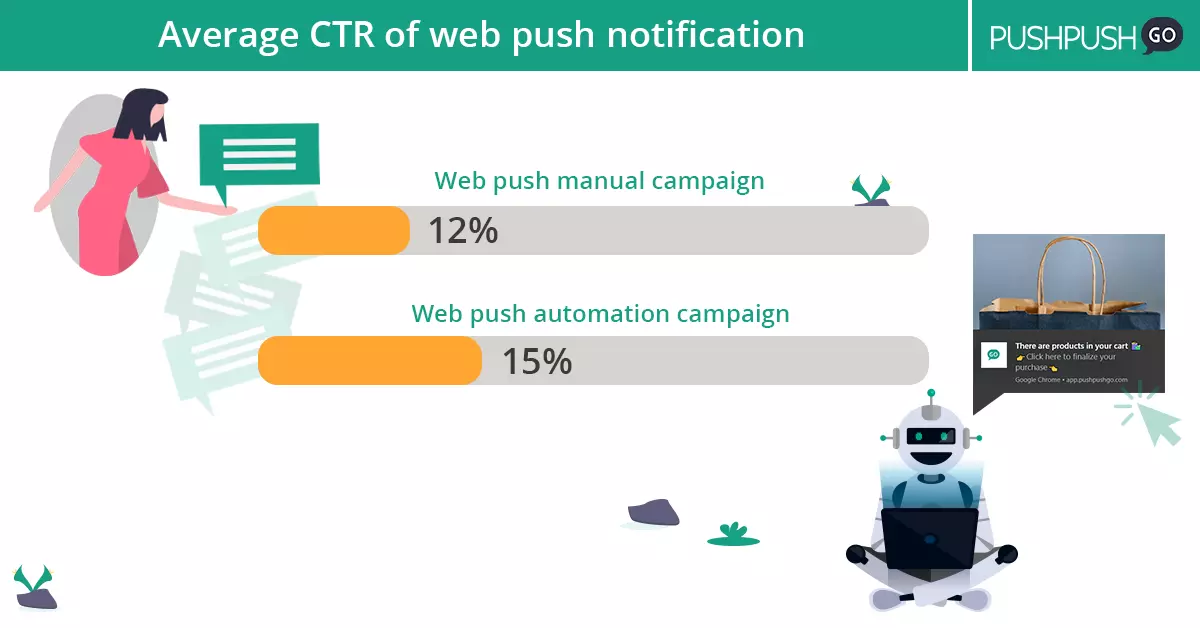
Geolocation, tagging on the basis of interests, tracking user behavior on the website - all these features help notifications reach the right people, and the CTR easily exceeds 15%.
Although web push notifications are small messages and you only have a little over 100 characters available, how you use them is important.
The content must be encouraging enough for the user to click on the notification and go to the page. Eye-catching graphics play a big role here, of course.
Interestingly, notifications that contain emoticons have higher CTR rates than those without them.
If you are interested in conversions, and not in the article views themselves, CTR alone will not tell you much. However, it opens up a field for you to analyze further indicators.
For example: If the CTR itself is high, and the conversion rate is low, it is a sign that you should take care of landing page optimization or any other subpage to which directs your advertising.
Words enthusiast both in literature and marketing. At PushPushGo responsible for developing content strategy and writing everything that needs to be written.
-3pf2xltbnb.webp)
-kzjq5bkqnz.webp)
-7qtlabfqyy.webp)