


-infv1ikejk.webp)
How do you get users to actually use your mobile app? How can you boost its visibility and encourage them to return? Here are essential strategies to make your app stand out and drive steady engagement.
You might think that writing a top-notch mobile app is enough - and people online will flock to your product in the app store. The reality is vastly different. Soon, mobile app marketing efforts will take up the majority of your time and strength. Why?
As you can see, promoting your mobile apps goes way beyond just convincing people to download. In this article, we won't talk about the technical matters - making your app user friendly, bug-free, and useful to your target audience - that's for your product managers and app developers to decide.
We'll also assume you did your market research, competitor research, and learned what your potential users are looking for in the app's features. Instead, we'll focus on good communication, building app visibility, and creating promotional strategies across your channels.
Yes, there's one more funny abbreviation you need to know. ASO, or App Store Optimization, is a process of improving the visibility and ranking of a mobile app in an app store (such as Apple’s App Store or Google Play) to increase organic downloads.
It is similar to SEO (Search Engine Optimization) but focused on app marketplaces. ASO involves optimizing various elements of an app’s store listing and user engagement factors, including:
The main goal of ASO is to increase app discoverability, drive more organic installs, and improve user retention by aligning the app’s store presence with user search behavior and expectations. In other words, you want to make sure that users find your app in the app store by browsing.
There are many great resources for creating catchy and informative descriptions and visual elements of the storefront. But we're ready to help with gathering reviews and asking users to contribute with positive ratings. Remember, people are more likely to leave a negative review unprompted. If you want them to say something nice, you need to ask.

This is where mobile push notifications and in-app notifications come in handy. Use them to appeal to your existing users and ask them for reviews. I hope I don't have to add that in the first place, you need to make your mobile app actually praiseworthy.
Keep in mind that:
Here, your mileage may vary, depending on your business model. If you have an existing website with its user base and actual products, and the mobile app is just a new channel of communication, you have a marketing strategy and a plethora of tried and tested tools for communicating with your user base.
Pop-ups - love them or hate them - are one of the simplest and most common ways to address the website visitors. And it works. According to one case study, a pop-up can increase app downloads by a whopping 700%.

Source: Israel Post
Just remember:
Onsite notifications are designed to guide and help. With their sleek design, they're unobtrusive. And their targeting options can help you address your users with helpful suggestions to download an app at different stages of their user journey
For example, you can suggest that if they download the app, they'll get clearer access to their user preferences and options. Or maybe they'll be the first ones to know about the new features in your offer? How about giving new app users a discount on their first purchase? Or creating loyalty programs for them?
Keep it short, timely, and non-intrusive.
The key is to start figuring out your mobile app marketing strategies before the launch.
A PushPushGo's blog post wouldn't be complete without a chapter about our web push notifications. Web push notifications are our bread and butter, and we can see them being used in mobile app marketing.
For example, you can set a web push automation to advertise your mobile app. According to the data gathered for the annual web push performance report, in 2024, the app promotion automation had a CTR of 3,13%.
What should you consider when planning a marketing campaign with web push notifications?
Use your email newsletters to send word about your new app. The email format allows you to better showcase the app's functionalities and acquire users. But just like with your web push messages, mind the timing.
And if you're using the omnichannel approach to communicating with your loyal users, use scheduling tools to distribute the messages evenly, not everything at once.
Overall, create valuable content marketing resources: make sure your content writer knows exactly what the user persona is, where to find them, and what language they should employ.
Social media platforms add another layer of value to your marketing strategy. It's especially important if your business model is concentrated in the app and you don't have a website to promote.
There are some more rules of thumb when it comes to social media campaigns: The key is to stay consistent, relevant, and authentic while keeping the app’s value clear.
User acquisition is just one side of the coin. You need to take care of the retention as well. In this aspect, the data is harsh.
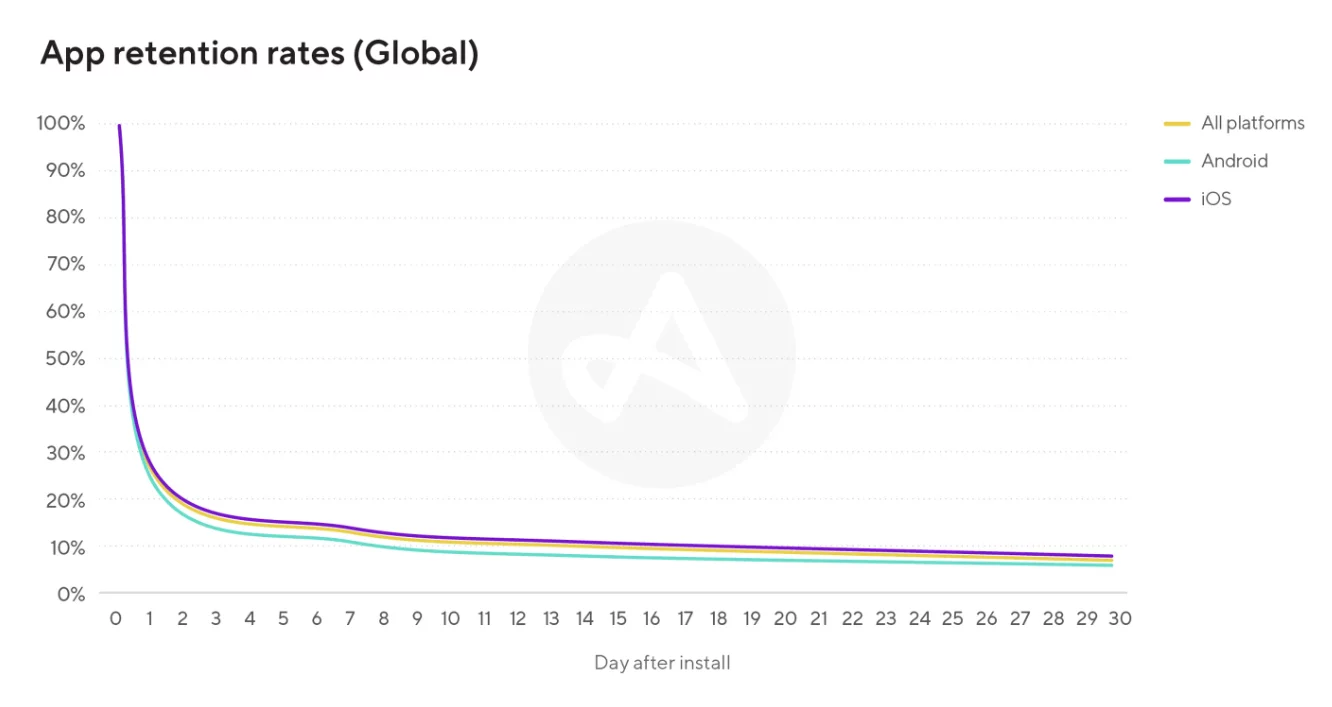
Source: Adjust
The retention rates can be broken down by operating systems, global regions, and industries. Still, the main takeaway is simple: after day 1, users are most likely to forget about your app until it's time to clean up some space on their mobile devices - then, they just uninstall it. And retention rates are also taken into consideration in app store optimization, as much as download rates.

When you run a website, there's a wide array of strategies and channels linking directly to your address. With mobile apps, push notifications are a powerful tool and your best bet to keep loyal users engaged.
With mobile push notifications, you can:
In the old days, push notifications operated in an opt-out format. Now, there's an opt-in solution, which means you need to ask your new users for permission. The prompt is usually displayed when the app user opens it for the first time.
Summary:
Getting people to download your app is only half the battle. Real success comes from making them use it regularly and keeping retention rates high. With millions of apps competing for attention on both the Google Play Store and Apple Store, app marketing requires a comprehensive mix of strategies across different channels, including web and mobile push notifications. Simply creating a high-quality app is not enough; promoting, improving its visibility, and engaging users effectively are essential steps to ensure your product stands out and continues to provide value to your audience.
1. App Store Optimization (ASO)
The first step in improving your mobile app’s discoverability is App Store Optimization, or ASO. ASO is similar to SEO, but focused on app marketplaces. Optimizing your app store listing is critical because it helps potential users find your app when browsing or searching in the app store. Key components of ASO include:
Investing time in ASO ensures that app is not only visible but also appealing to potential users, which helps drive organic installs and improve retention over time.
2. Push notifications and in-app messages
Once users download your app, keeping them engaged is critical. Push notifications and in-app notifications are powerful tools for boosting retention. The timing, content, and frequency of these messages make all the difference:
Effective push and in-app notifications help maintain a steady engagement cycle and remind users why your app is valuable, increasing the likelihood they return regularly.
3. Website integration and pop-ups
If your business has an existing website, leveraging it to promote your app can be highly effective. Pop-ups, while often controversial, remain one of the simplest ways to capture attention and encourage downloads.
Additionally, onsite notifications can be used to gently guide users toward your app. These notifications are unobtrusive, visually appealing, and can provide incentives like early access to features, discounts, or loyalty rewards.
4. Web push notifications, email, and social media
Beyond your website, other digital marketing channels are critical for driving app downloads and engagement. A multi-channel approach ensures that your app reaches users wherever they are:
Using these channels strategically can expand your app’s reach, attract new users, and keep existing users informed and engaged.
5. Focus on retention and loyal users
User acquisition is only one side of app marketing. Retention is equally, if not more, important. Data consistently shows that many users forget about apps shortly after downloading them, and retention rates often decline week by week. To improve retention, use mobile push notifications.
Existing users not only provide ongoing value but also become advocates for your app, sharing it with friends and helping to grow your audience organically.
Conclusion
Promoting an app successfully involves much more than just development. From App Store Optimization to push notifications, website integration, and multi-channel marketing campaigns, every step plays a role in boosting visibility, driving downloads, and maintaining user engagement. By focusing on retention, clear communication, and strategic promotion, you can turn first-time users into loyal advocates and ensure your app stands out in an increasingly crowded marketplace.
If you want to learn more about our tools, including web push notifications, mobile push notifications, transactional push notifications, onsite notifications and pop-ups, drop us a line.
Editor and writer. She is interested in media and new technologies.
.png)
.png)
-3pf2xltbnb.webp)