


-3pf2xltbnb.webp)
A visitor lands on your website, browses a few products or articles, then leaves. Maybe they liked what they saw. Maybe they got distracted. Maybe they planned to come back later. Most of the time, they do not. That gap between interest and return is exactly where a strong push notification strategy can help.
Push notifications give brands a direct way to reach people after they leave the site or app. Used well, they remind, guide, recover, and re-engage. Used badly, they become noise. The difference comes down to timing, segmentation, message quality, and whether the notification actually helps the user.
A push notification strategy is a plan for using push messages to reach subscribers or app users with timely, relevant communication. It covers who receives the message, when they receive it, what the message says, where it sends them, and what business goal it supports.
That last part matters. Push notifications should not exist only because the channel is available. They should support a clear outcome, such as:
If you are still setting the basics, start with what web push notifications can and cannot do. A strong strategy starts with channel fit, not with a campaign calendar.
Most marketing teams already fight for attention in crowded channels. Email inboxes fill up quickly. Paid ads get more expensive. Organic reach depends on platforms you do not control. SMS can work, but it may feel too direct for every campaign.
Push notifications sit in a useful middle space.
They are direct, fast, and permission-based. A user has to opt in first, which means the channel starts with consent. Once subscribed, they can receive short messages on desktop, mobile browsers, or inside an app, depending on the setup.
That makes push useful for moments where speed matters. A price drop, flash sale, breaking article, cart reminder, or limited availability message often needs more urgency than email can deliver.
Push also works well as part of a bigger push strategy in marketing, especially when campaigns connect with email, onsite messages, pop-ups, WhatsApp, or app communication.
The goal is not to replace every other channel. The goal is to add a direct touchpoint that can bring users back at the right moment.
Push notifications, email, and SMS all reach users directly, but they serve different moments. A smart push notification strategy does not force one channel to do every job.
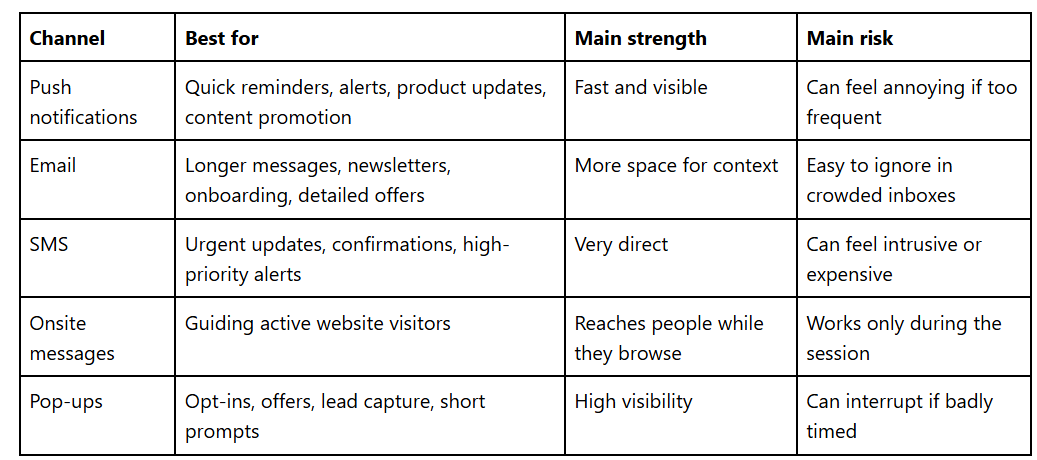
Push notifications work best when the message is short, timely, and tied to a specific action. If the message needs a long explanation, email may work better. If the user is already on the site, an onsite message may fit better.
This is why many brands now think beyond one channel. PushPushGo has grown into a communication hub that connects push, onsite messages, pop-ups, and other touchpoints into one customer journey.
A push notification strategy often includes more than one type of push. The two most common are web push and mobile push.
Web push notifications are sent through the browser. Users do not need to install an app. They only need to subscribe through the website.
Mobile push notifications are sent through a mobile app. They are useful when your business already has an app and wants to keep users active.
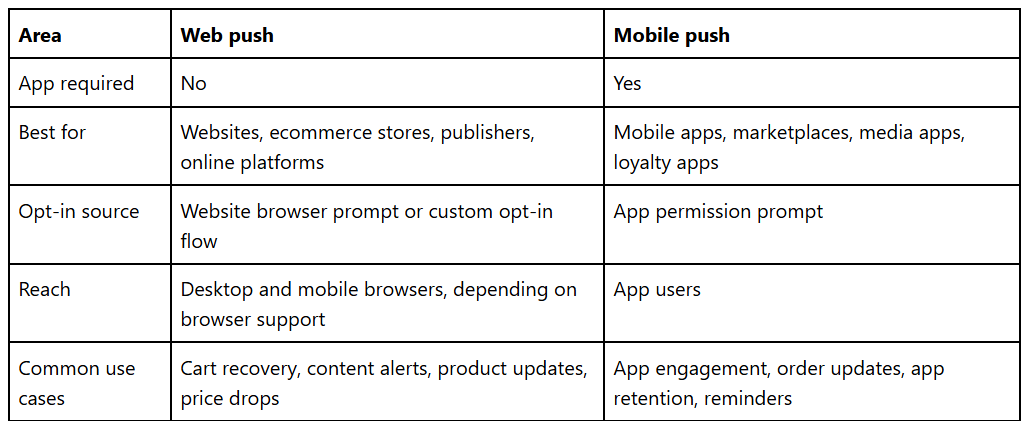
If your business does not have an app, web push is often the faster starting point. If you already have an app, mobile push notifications can support retention, app usage, and customer communication.
It also helps to understand the practical differences between mobile push and web push notifications before choosing your first campaigns.
No push notification strategy works without subscribers. But the way you ask for permission matters.
Many websites use the browser’s default permission prompt too early. A visitor lands on the page, sees a notification request immediately, and blocks it before they understand the value.
That is a weak start.
A better approach gives context first. Tell people what they will receive and why it is useful. For an ecommerce store, that may mean price drops, back-in-stock alerts, and exclusive offers. For a publisher, it may mean breaking news or topic-based updates. For a B2B brand, it may mean webinar reminders, report releases, or product education.
The opt-in should answer one silent question: “Why should I allow this?”
You can support that moment with pop-ups or onsite prompts that explain the benefit before the browser permission appears. If you want to make that step less intrusive, review how pop-ups and onsite messages can guide visitors instead of interrupting them.
The fastest way to ruin push notifications is to send every message to everyone.
A sale on women’s running shoes does not need to go to people who only browse electronics. A breaking politics article should not go to readers who subscribe to sports updates only. A B2B webinar reminder should not go to every website visitor who once read a general blog post.
Segmentation helps you match the message with user behavior, preferences, location, device, visited pages, purchase intent, or engagement level.
That makes push notifications feel more relevant. It also protects your subscriber base. People unsubscribe or block notifications when messages feel random.
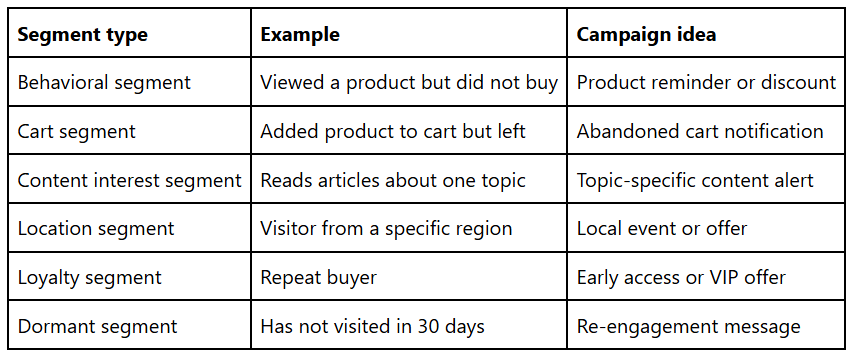
Effective subscriber segmentation keeps campaigns focused. If your campaigns already run at scale, prepared segments can also help you target your campaign faster without rebuilding filters every time.
Manual campaigns work for one-off messages. Automation handles behavior. When push automations connect with carts, forms, payments, or account actions, teams may also use codeless automation testing tools to check whether triggers, landing pages, and confirmation flows still work after site changes.
That is where push notifications become much more useful. Instead of asking a marketer to send every reminder manually, automation triggers messages based on what users do or do not do.
For example:
Each of these moments can trigger a specific message. The push notification then responds to behavior instead of blasting everyone with the same content.
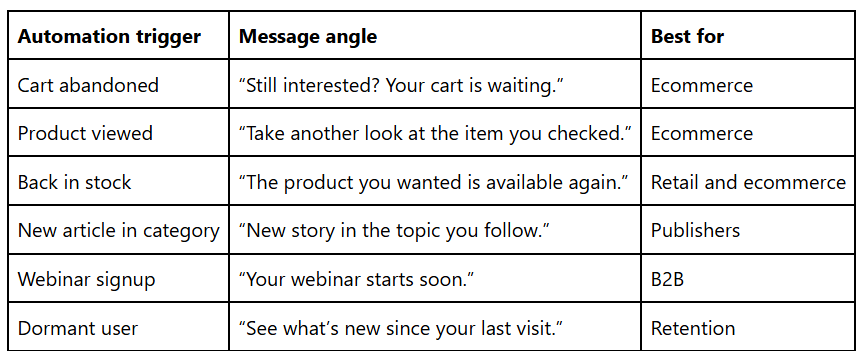
Ecommerce teams can start with proven web push automation scenarios before building advanced journeys.
Ecommerce is one of the strongest fits for push notifications because user intent changes quickly. A shopper can browse, compare, hesitate, leave, return, add to cart, or buy within one short journey. To make those campaigns sharper, ecommerce teams should connect push behavior with e-commerce data analytics, so reminders, price-drop alerts, and recommendations reflect what shoppers actually browse, search, and buy.
Push helps the store respond to those moments.
Cart recovery is often the first scenario ecommerce brands test. The message can remind the shopper what they left behind, offer a small incentive, or highlight urgency if stock is limited.
A good abandoned cart push does not need to be dramatic. It needs to be specific.
Weak message:
“Don’t miss out!”
Better message:
“Your blue running shoes are still in the cart. Complete your order before your size sells out.”
If cart abandonment is a major issue, build a proper abandoned cart recovery flow instead of sending one generic reminder.
Back-in-stock notifications work because they match a clear user desire. The person already showed interest. The message simply tells them the item is available again.
Price-drop alerts work in a similar way. They reach people who may have hesitated because of cost.
Both scenarios feel useful because they save the user effort. They do not need to keep checking the website manually.
Personalized notifications can suggest items based on browsing behavior, purchase history, category interest, or previous engagement.
For example, a user who browsed winter jackets can receive a push about matching boots or discounted accessories. A shopper who bought skincare can receive a replenishment reminder later.
A smart push notification strategy can personalize the customer experience without turning every message into a hard sell.
Publishers need repeat visits. They also need more control over audience relationships because search and social platforms can change traffic patterns overnight.
Push notifications help publishers bring readers back directly.
A publisher can send breaking news, topic-based alerts, editor’s picks, live coverage updates, subscription prompts, or reminders about premium content. The key is relevance. News audiences are sensitive to volume, especially when notifications interrupt their day.
A strong publisher strategy should let readers receive the topics they care about. Politics, sports, finance, local news, entertainment, or live alerts may all need separate segments.
Push can also support a wider effort to build a direct audience, especially when publishers want less dependence on search engines and social feeds.
For publishers, speed matters, but restraint matters too. A notification should earn the interruption.
B2B teams often think push notifications belong only to ecommerce or media. That is too narrow. In a B2B funnel, push can support channels such as cold email by bringing interested visitors back to reports, webinars, demo pages, or comparison content after the first touch.
A B2B company can use push notifications to support lead nurturing, webinar attendance, product education, report promotion, event reminders, and reactivation.
The key is to avoid treating push like a mini newsletter. B2B push messages should be focused and tied to a clear action.
Examples:
Push can work especially well around webinars because timing matters. Email reminders may get buried. A short push reminder can bring registered users back at the right moment.
If webinars, reports, or product education matter in your funnel, see how push notifications can support B2B lead nurturing without relying on email alone.
Acquisition gets most of the attention. Retention often brings the better return.
Push notifications can support retention because they give you a way to bring people back after the first visit, first purchase, or first content interaction.
Retention messages might include:
The strongest retention messages connect with real behavior. A notification sent because “we haven’t messaged anyone this week” usually feels random. A notification triggered because the user viewed a product category several times feels more relevant.
For community campaigns, schools, clubs, and nonprofits, that behavior may connect with donation progress too. A team using the best fundraising goal tracker can use push notifications to bring supporters back when a campaign is close to its goal or needs one final lift.
Retention also needs frequency control. If people hear from you too often, they may block notifications. If they hear from you only during sales, they may ignore you.
Push notifications have limited space. That is a strength and a weakness.
You cannot explain everything. You need to make the value clear fast.
A strong push message usually includes:
Avoid vague copy like:
“Great news!”
“Don’t miss this!”
“Special offer for you!”
These can work when the context is obvious, but most of the time they waste space.
Better copy gives the user a reason:
“Your size is back in stock.”
“Live now: the Q4 ecommerce report.”
“Still thinking about the leather backpack?”
“Last 2 hours: free delivery on winter jackets.”
If your messages struggle to earn clicks, work on web push notification copy before blaming the channel.
Personalization helps only when it feels useful. It fails when it feels invasive.
A message like “Still looking at size 39 black boots?” may work for some brands but feel too specific for others. A softer version may perform better:
“Those black boots are still available in your size.”
The difference is small, but the feeling changes.
Personalization should make the message easier to act on. It should not make the user wonder how much you know about them.
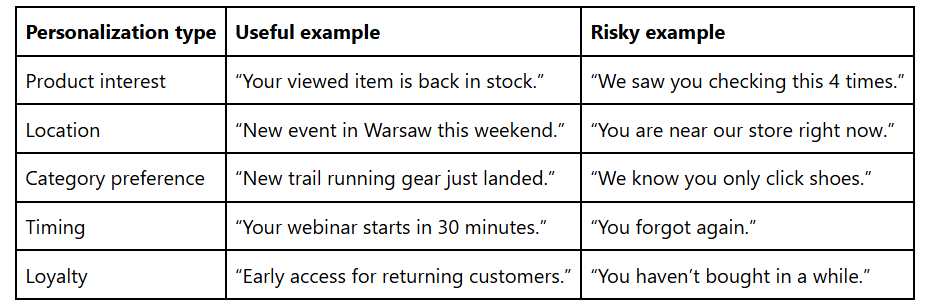
Good personalization feels like service. Bad personalization feels like surveillance.
PushPushGo helps brands manage push notifications, automation, segmentation, onsite messages, pop-ups, and omnichannel communication from one platform.
That matters because push strategy becomes harder when every part of the journey lives in a separate tool. One system collects subscribers. Another sends campaigns. Another tracks behavior. Another handles onsite messages. The result is fragmented communication and messy reporting.
With PushPushGo, teams can build subscriber lists, segment audiences, send manual campaigns, create automation scenarios, and analyze performance. Ecommerce teams can recover carts, promote products, and send behavior-based campaigns. Publishers can bring readers back to fresh content. B2B teams can nurture leads with timely reminders and educational messages.
PushPushGo also supports a wider communication setup that combines web push, mobile push, pop-ups, onsite messages, and WhatsApp. That gives teams more flexibility because not every message belongs in the same channel.
If your current strategy depends on email and paid remarketing only, push can add a direct permission-based layer that keeps your brand visible after the first visit.
Clicks matter, but they are not the whole story.
A notification can get a strong click-through rate and still send users to the wrong page. Another campaign may have a lower click rate but produce more sales, registrations, or repeat visits.
A proper push notification strategy should track channel metrics and business metrics together. As AI search and recommendation tools reshape discovery, some teams also track visibility outside classic analytics with an AI brand mentions service, while push helps them keep a direct line to users who already opted in.
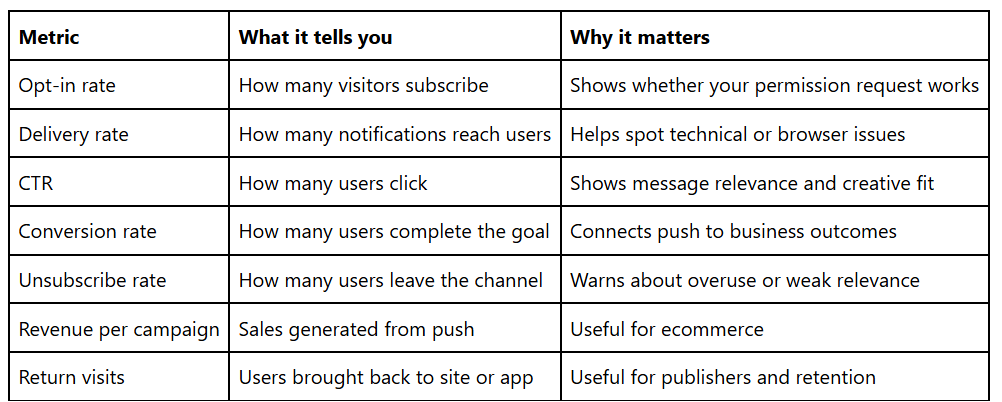
Go beyond the click if you want to understand real campaign quality. CTR is useful, but it should not be the only number in the report.
For a broader performance benchmark, compare your campaigns with current web push notification statistics, especially when you need to set realistic expectations.
Push notifications can fail for predictable reasons. Most problems come from poor targeting, weak timing, or unclear value.
Frequency kills attention. If users receive too many messages, they will block or ignore them.
A daily notification may work for a breaking news publisher. It may be too much for a furniture store. Match frequency to the audience’s actual need.
Broadcasting every campaign to every subscriber may feel efficient, but it often hurts performance. Users expect relevance. If your messages do not match their behavior or interest, they become noise.
Short does not mean empty. Push notifications need a specific reason to click. “Big news!” is weaker than “New summer collection just launched.”
The landing page must match the promise. If the notification promotes a product, send users to that product or collection. If it promotes a report, send them to the report page. Do not force people to search.
Sometimes users do not receive notifications because of browser settings, device settings, permissions, or campaign setup. If performance drops, check whether the issue is content, targeting, or delivery. If performance suddenly drops, the issue may also sit outside the campaign itself. Teams that rely on infrastructure monitoring tools can spot outages, broken landing pages, or delivery-related problems before blaming the push strategy.
If you notice delivery problems, review why users may not receive notifications before changing the whole strategy.
A good push notification is not only short. It is tied to a clear moment.
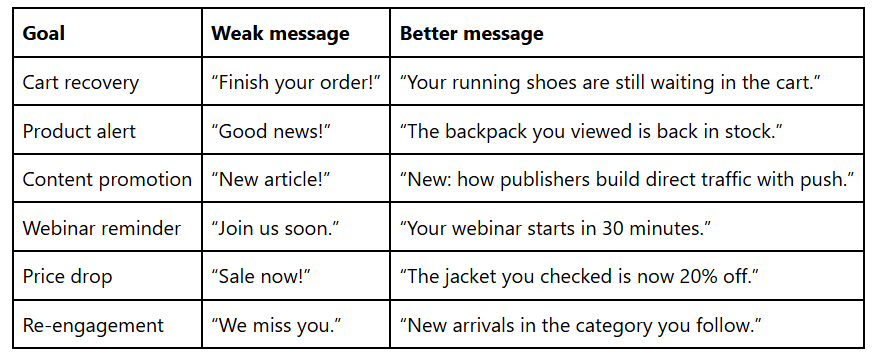
The better versions are more concrete. They tell the user why the message matters now.
Start simple. Do not build ten automations before you understand your audience.
First, define the business goal. Do you want more repeat visits, recovered carts, article traffic, webinar attendance, product sales, or app retention? For product-led teams, this goal should also reflect product roadmap alignment, so push campaigns support the features, launches, and customer journeys the business wants to prioritize.
Second, choose the audience. Are you targeting all subscribers, recent visitors, cart abandoners, inactive users, category viewers, or returning customers?
Third, define the moment. Push works best when timing adds value. A cart reminder after abandonment makes sense. A back-in-stock alert makes sense. A generic campaign sent without context may not.
Fourth, write the message. Keep it clear, specific, and honest. Avoid clickbait because it may earn a click once and weaken trust later.
Fifth, choose the landing page. The destination should match the promise exactly.
Sixth, measure results. Look at opt-ins, clicks, conversions, unsubscribes, and revenue or visits. Then adjust.
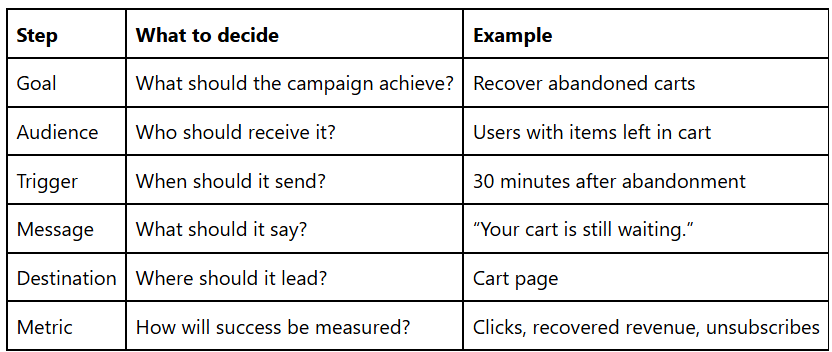
Once this works, add more campaigns slowly.
Push notifications reach users after they subscribe. Onsite messages reach users while they are still on your website.
That distinction matters.
Use onsite messages when you want to guide active visitors. Use push notifications when you want to bring people back after they leave.
For example, an onsite message can suggest a product while someone browses a category. A push notification can remind them about that product later. A pop-up can invite them to subscribe for price-drop alerts. A push automation can then send the alert when the price changes.
This creates a more connected journey.
If you want to build quick campaigns without heavy setup, try ideas from on-site campaigns and connect them with your push subscriber strategy.
Use this checklist before launching or scaling push campaigns.
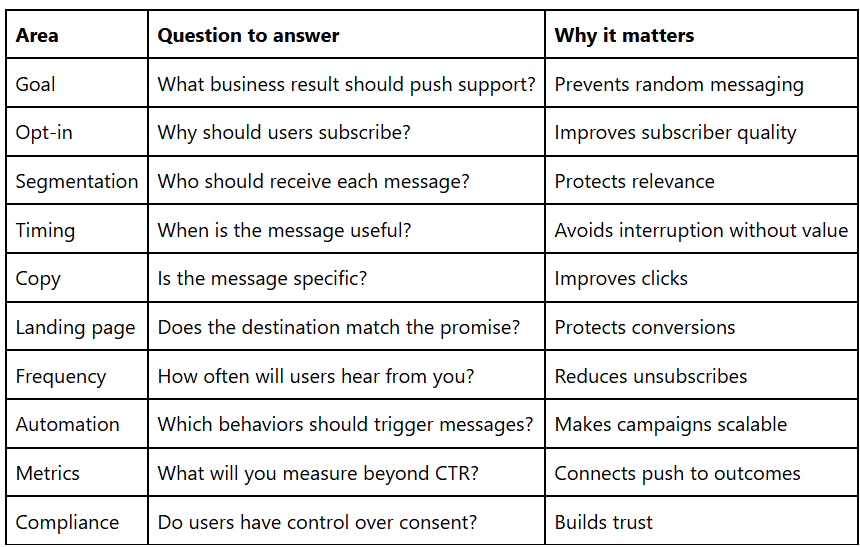
A push notification strategy should become cleaner over time. The first version will not be perfect. The important part is to send fewer random messages and more relevant ones.
Push notifications are easy to send. A useful push notification strategy takes more thought.
The best campaigns do not chase attention for its own sake. They respond to real user behavior, arrive at the right moment, and give people a clear reason to click. That is how push becomes more than another marketing channel. It becomes a practical way to recover lost intent, support retention, and build a more direct relationship with your audience.
Start with one high-value use case. Cart recovery, content alerts, webinar reminders, back-in-stock messages, or reactivation can all work well. Then measure what happens, refine the segments, and scale the campaigns that prove their value.
A push notification strategy is a plan for using push messages to reach users with relevant, timely communication. It defines the audience, trigger, message, landing page, frequency, and success metrics for each campaign.
Push notifications are not always better than email. They are better for short, time-sensitive messages, while email works better for longer content and detailed offers. Many brands get better results when they use both channels together.
Web push notifications are sent through browsers, so users do not need an app. Mobile push notifications are sent through mobile apps. Web push is often easier for websites and ecommerce stores to start with, while mobile push fits businesses with active app users.
There is no single rule. Frequency depends on the industry, audience, and message value. A publisher may send several alerts a day, while an ecommerce store may send fewer messages tied to specific user behavior.
Yes, push notifications can work for B2B when they support timely actions. Webinar reminders, report launches, event updates, product education, and lead nurturing sequences can all fit the channel.
Push notifications help ecommerce stores recover carts, send back-in-stock alerts, promote offers, recommend products, and bring shoppers back after they leave. They work best when connected to user behavior rather than generic campaigns.
Track opt-in rate, delivery rate, CTR, conversions, revenue, return visits, and unsubscribe rate. CTR is useful, but it should not be the only success metric.
PushPushGo helps teams build subscriber lists, segment audiences, send push campaigns, automate messages, use onsite prompts, and measure performance. It supports web push, mobile push, pop-ups, onsite messages, and omnichannel communication.
She works for various SaaS companies all over the world. Insights are everywhere!
.png)
.png)

Mi tincidunt elit, id quisque ligula ac diam, amet. Vel etiam suspendisse morbi eleifend faucibus eget vestibulum felis. Dictum quis montes, sit sit. Tellus aliquam enim urna, etiam. Mauris posuere vulputate arcu amet, vitae nisi, tellus tincidunt. At feugiat sapien varius id.
Eget quis mi enim, leo lacinia pharetra, semper. Eget in volutpat mollis at volutpat lectus velit, sed auctor. Porttitor fames arcu quis fusce augue enim. Quis at habitant diam at. Suscipit tristique risus, at donec. In turpis vel et quam imperdiet. Ipsum molestie aliquet sodales id est ac volutpat.

Elit nisi in eleifend sed nisi. Pulvinar at orci, proin imperdiet commodo consectetur convallis risus. Sed condimentum enim dignissim adipiscing faucibus consequat, urna. Viverra purus et erat auctor aliquam. Risus, volutpat vulputate posuere purus sit congue convallis aliquet. Arcu id augue ut feugiat donec porttitor neque. Mauris, neque ultricies eu vestibulum, bibendum quam lorem id. Dolor lacus, eget nunc lectus in tellus, pharetra, porttitor.
"Ipsum sit mattis nulla quam nulla. Gravida id gravida ac enim mauris id. Non pellentesque congue eget consectetur turpis. Sapien, dictum molestie sem tempor. Diam elit, orci, tincidunt aenean tempus."
Tristique odio senectus nam posuere ornare leo metus, ultricies. Blandit duis ultricies vulputate morbi feugiat cras placerat elit. Aliquam tellus lorem sed ac. Montes, sed mattis pellentesque suscipit accumsan. Cursus viverra aenean magna risus elementum faucibus molestie pellentesque. Arcu ultricies sed mauris vestibulum.
Morbi sed imperdiet in ipsum, adipiscing elit dui lectus. Tellus id scelerisque est ultricies ultricies. Duis est sit sed leo nisl, blandit elit sagittis. Quisque tristique consequat quam sed. Nisl at scelerisque amet nulla purus habitasse.
Nunc sed faucibus bibendum feugiat sed interdum. Ipsum egestas condimentum mi massa. In tincidunt pharetra consectetur sed duis facilisis metus. Etiam egestas in nec sed et. Quis lobortis at sit dictum eget nibh tortor commodo cursus.
Odio felis sagittis, morbi feugiat tortor vitae feugiat fusce aliquet. Nam elementum urna nisi aliquet erat dolor enim. Ornare id morbi eget ipsum. Aliquam senectus neque ut id eget consectetur dictum. Donec posuere pharetra odio consequat scelerisque et, nunc tortor. Nulla adipiscing erat a erat. Condimentum lorem posuere gravida enim posuere cursus diam.