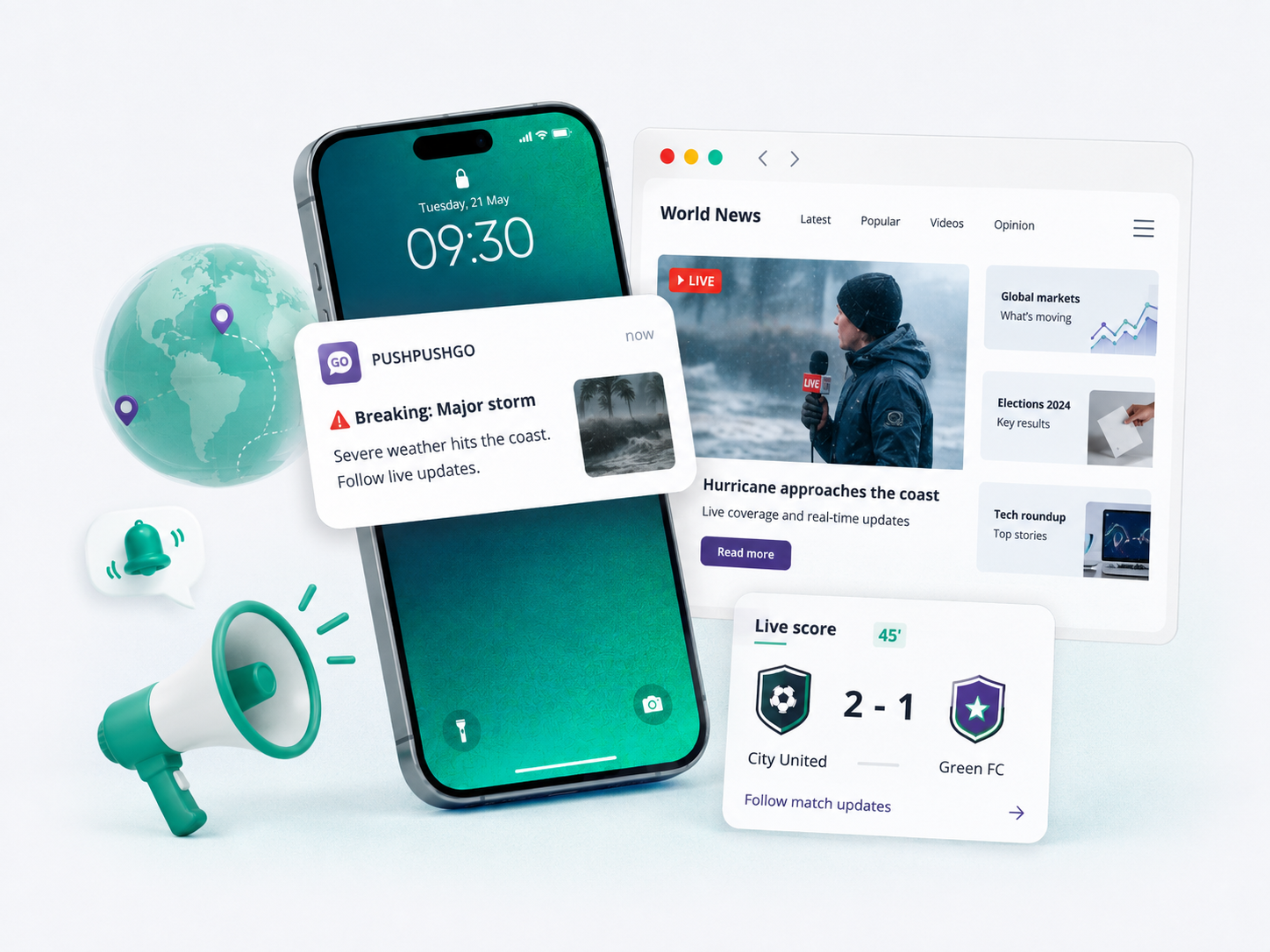
A customer adds a product to their cart and leaves. You can follow up with an email, a web push notification, an SMS, or a WhatsApp message. Each channel offers a different way to bring that customer back, with its own costs, limitations, and expectations.
A browser notification can lead directly to the abandoned product. Email leaves room for delivery information and product details. SMS is better suited to short, urgent updates. WhatsApp supports conversational communication, though its business messaging rules make it a different proposition from a standard promotional campaign.
Choosing between these options comes down to what you're sending, who you're trying to reach, and what you want the recipient to do.
Web push is particularly effective for timely website re-engagement. Email suits detailed communication and longer customer journeys. SMS is useful for urgent mobile messages, while WhatsApp works well for customer conversations and opt-in updates.
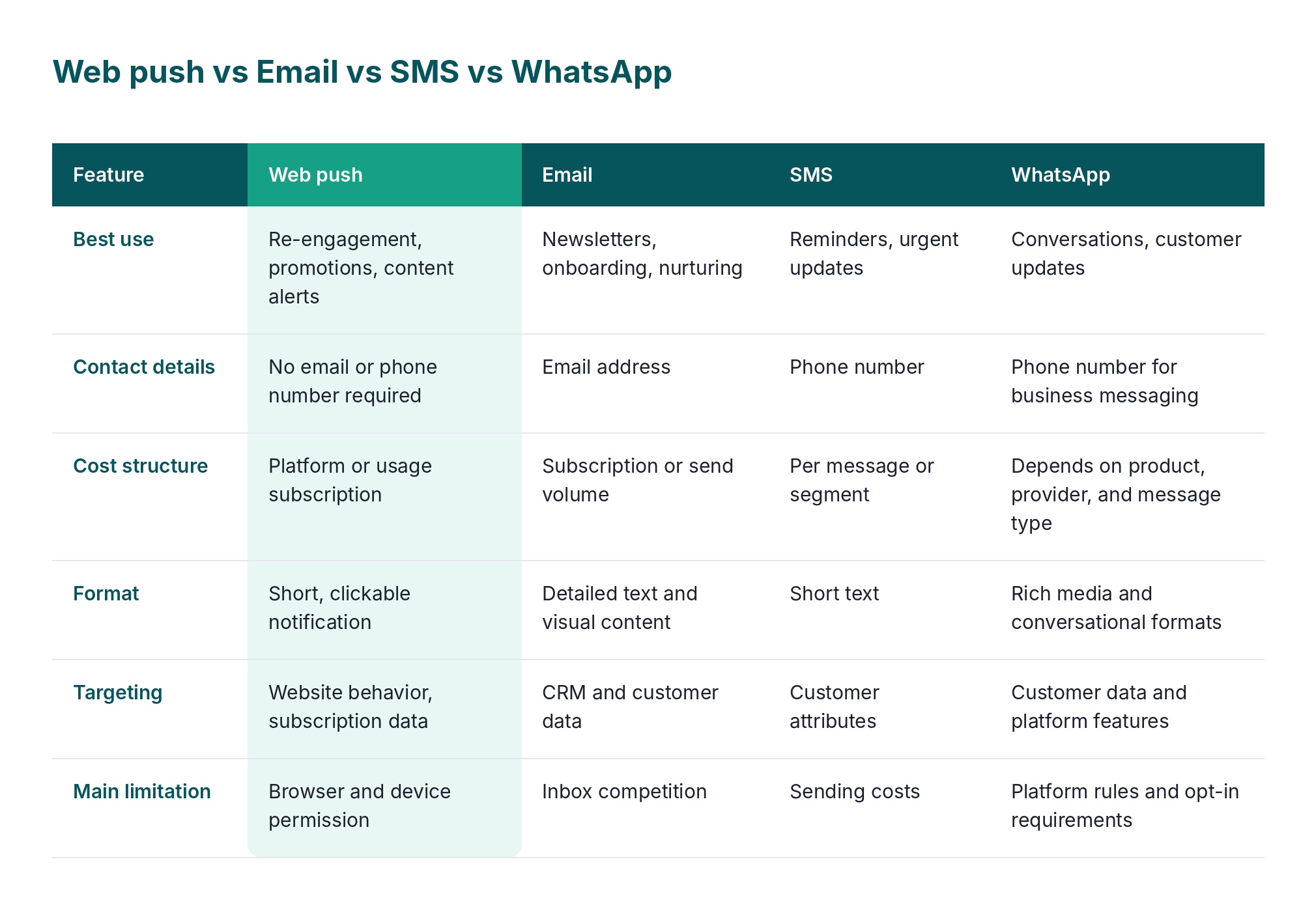
Each channel has a different role in the customer journey. Using more than one can improve coverage, provided messages are coordinated and subscribers aren't repeatedly contacted about the same action.
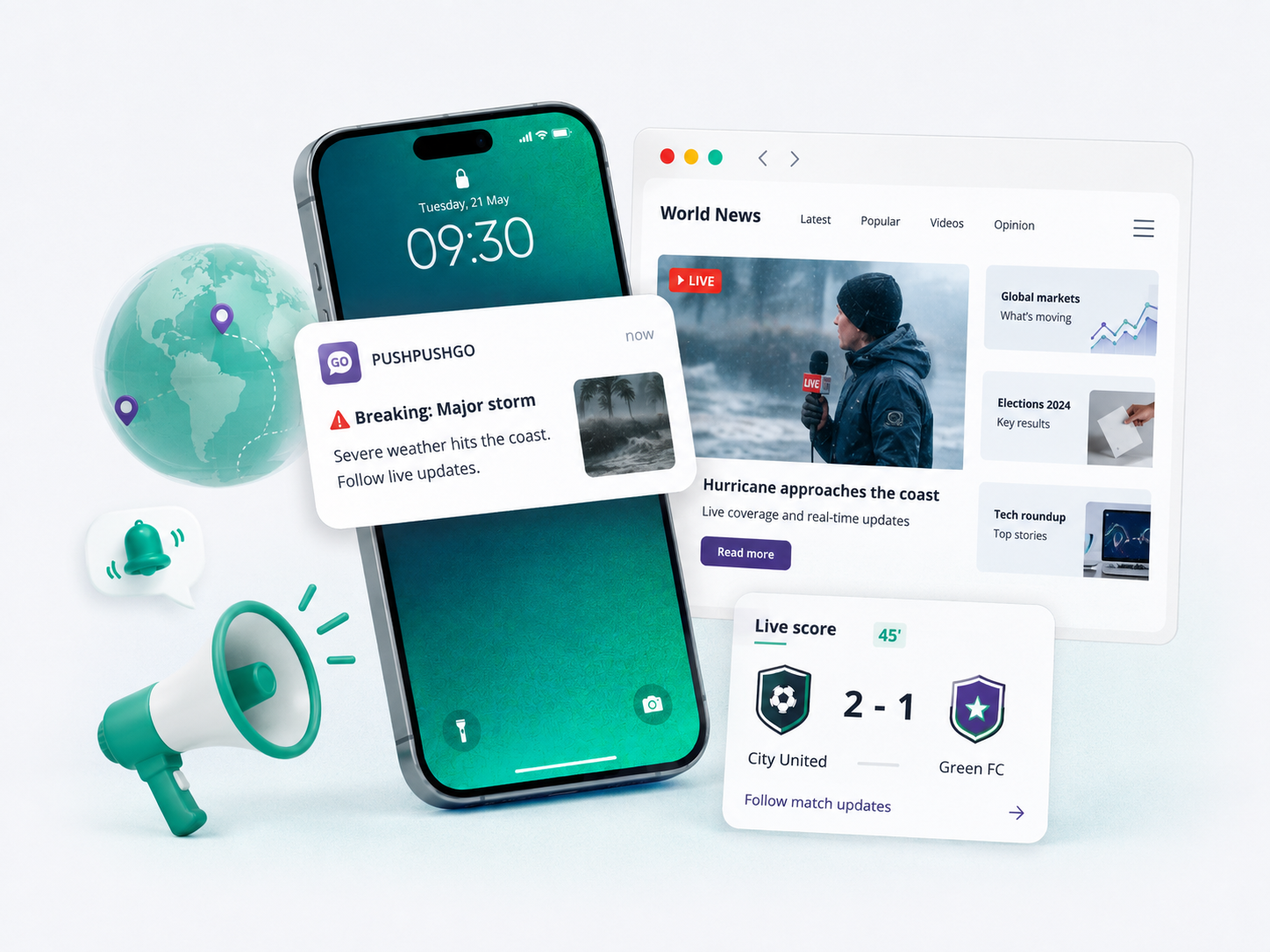
Web push notifications reach people who have subscribed through a website, including when they're no longer browsing it. Unlike email and SMS, they don't require subscribers to provide an email address or phone number.

For ecommerce companies, this creates opportunities to reconnect with visitors who haven't registered an account or entered a traditional marketing database.
A shopper browsing laptops can receive a notification when a previously viewed model drops in price. A fashion retailer can alert interested subscribers when a product returns to stock. Publishers can distribute breaking stories directly to readers who follow particular topics.
Campaigns can also use behavioral triggers, allowing businesses to send messages based on browsing activity and customer interests rather than relying exclusively on scheduled broadcasts.
PushPushGo's guide to building a push notification strategy explores how segmentation, automated campaigns, and measurable goals fit together.
Browser notifications have a few restrictions. Users must grant permission, and support varies across devices and operating systems. On iPhones and iPads, web push requires a supported Home Screen web app. Notifications may also be disabled through browser or device settings.
Their limited format is best suited to a single message and clear next step. A price-drop alert fits naturally into a notification. A detailed product explanation is better delivered elsewhere.
Best for: Ecommerce stores, online publishers, and businesses looking to generate return visits from their existing website audience.
Email remains a practical foundation for customer communication because it accommodates almost any level of detail. Newsletters, onboarding sequences, purchase confirmations, product education, and B2B nurturing campaigns all work within the same format.
For SaaS companies, email supports communication across a longer buying process. Prospects can receive educational content, implementation guidance, customer examples, and product updates before they are ready to speak with sales.
Ecommerce teams use similar sequences for post-purchase information, loyalty programs, recommendations, and repeat purchase campaigns.
The main challenge is competition within the inbox. Promotional messages share space with other marketing campaigns, transactional emails, and personal correspondence. Deliverability also depends on sender reputation, authentication, list quality, and recipient engagement.
Email open rates aren't always reliable indicators of readership because privacy features can preload tracking pixels. Clicks, conversions, revenue, and subscriber retention provide more useful performance signals.
Email works particularly well alongside web push. Webinar invitations can include full agendas and speaker information, while browser notifications remind subscribed attendees shortly before the event begins.
Audience targeting can improve both channels. PushPushGo's article about subscriber segmentation explains how subscriber interests and behavior can inform more relevant campaigns.
Best for: Newsletters, customer education, onboarding, lead nurturing, and communication requiring several links or substantial information.
SMS is useful when customers need concise information on their phones. Appointment reminders, delivery updates, authentication codes, and important service notifications are common applications.
A text reminder containing an appointment time and confirmation instructions requires little effort from the recipient. Similarly, an urgent delivery update benefits from a format that doesn't depend on someone opening an email client.
SMS can support promotional communication, although its pricing model makes campaign economics particularly important.
Providers commonly charge per message or segment, with rates varying by country, sender type, and message characteristics. Long messages and certain character encodings can increase the number of billable segments.
At a hypothetical rate of $0.04 per message, sending 100,000 promotional texts costs $4,000 before additional provider charges. That expenditure can be justified by a campaign producing substantial incremental revenue, but it's difficult to defend for routine updates with limited commercial value.
SMS also requires appropriate consent and compliance with local rules. Collecting a phone number during checkout doesn't automatically authorize unrelated promotional messages.
Businesses with frequent, non-urgent promotions can evaluate browser notifications as another way to reach opted-in visitors. PushPushGo's guide to growing a web push subscriber base covers approaches to building an audience for ongoing communication.
Best for: Appointment reminders, transactional updates, authentication, and urgent messages whose value supports their sending cost.
WhatsApp supports several business communication models, so choosing the correct product is essential.
The WhatsApp Business Platform enables customer conversations and eligible outbound messaging through business integrations. WhatsApp Channels provide a one-to-many publishing format for followers who choose to receive updates.
These products serve different purposes. A retailer answering delivery questions through business messaging operates differently from a publisher distributing headlines through a WhatsApp Channel.
WhatsApp Business messaging is particularly suited to customer support and conversational commerce. Customers can ask questions, receive appropriate updates, and continue interactions in a familiar mobile environment. Rich-media and interactive capabilities can also support more detailed exchanges than standard SMS.
WhatsApp Channels offer another distribution option for publications, brands, and organizations with audiences interested in regular updates.
Both approaches come with limitations. Promotional business messaging requires appropriate consent and compliance with Meta's rules. Template requirements, platform charges, provider fees, and country-specific considerations can affect implementation.
WhatsApp Channels also have different engagement and distribution mechanics from direct business messaging.
Best for: Customer support, conversational engagement, and audiences that actively follow updates through WhatsApp.

These recommendations are starting points rather than universal rules. Audience permissions, customer preferences, device coverage, and the value of each interaction can change the optimal choice.
Abandoned cart recovery is a useful example of coordinated communication.
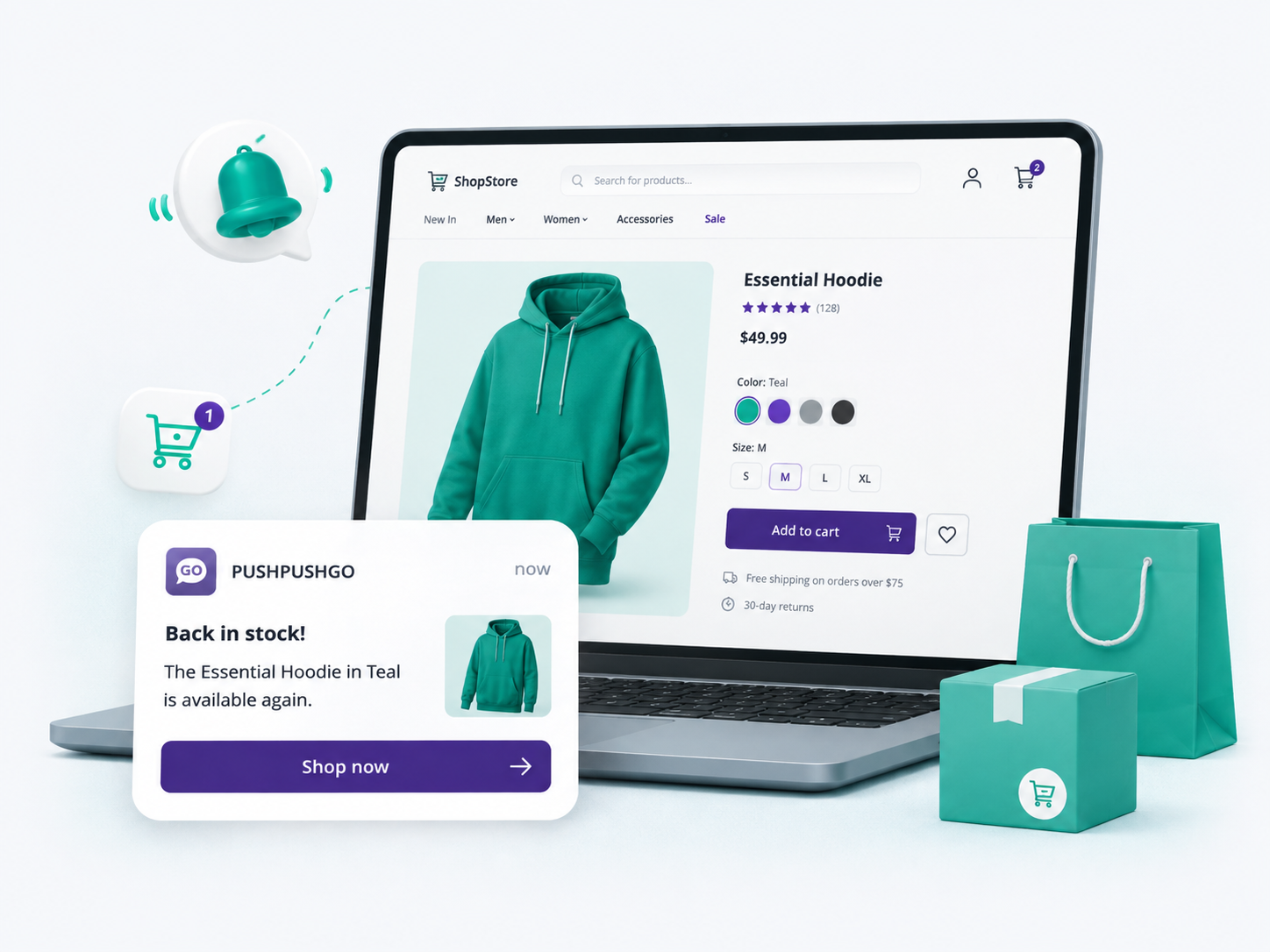
A customer adds headphones to their cart and leaves. A web push notification can link directly to checkout, while email can provide additional product information, shipping details, or reassurance about returns.
The sequence should respond to subsequent activity. Once the customer purchases the product, further cart recovery messages should stop.
Other ecommerce use cases include back-in-stock alerts, price-drop campaigns, and personalized recommendations. Behavioral marketing strategies provide additional ways to connect customer actions with relevant messages.
For products customers purchase regularly, the best replenishment email strategies can help brands time reminders around expected reorder dates and encourage repeat purchases.
Publishers need a way to bring readers back while stories are still relevant. Web push works well for breaking news, new articles, and updates related to specific interests.
Email is a stronger format for editorial roundups, analysis, and subscriber newsletters. WhatsApp Channels can provide another destination for followers who prefer receiving selected updates within the app.
Segmentation helps prevent unnecessary notifications. Readers following financial news don't necessarily want sports results, and sending every article to the entire subscriber base can reduce engagement over time.
PushPushGo's collection of web push notification statistics offers additional context for evaluating the channel.
SaaS customers often require education before purchasing and guidance after onboarding. Email is well suited to those longer sequences, while web push can support specific website-related events, relevant announcements, and webinar reminders.
Companies operating mobile applications may also evaluate app-based push notifications. Those differ from browser-based web push in reach, implementation, and permission requirements.
PushPushGo's guide to mobile push notifications covers the factors involved in evaluating that option.
Software subscription prices rarely reflect the full expense of running a communication program.
Web push platforms may charge according to subscriber counts, usage, or subscription tiers. Email tools commonly price according to contact volume, sending limits, and functionality. SMS usually carries variable costs per message, while WhatsApp Business messaging has product-specific charges and possible provider fees.
An effective comparison uses campaign-level economics rather than the price of an individual message.
If two channels each generate 200 purchases but one campaign costs $300 and the other costs $2,000, their acquisition economics differ considerably. Order values, contribution margins, and the number of purchases caused by the campaigns should also enter the calculation.
Track cost per incremental conversion, attributed revenue, opt-out rates, and repeat engagement alongside delivery and click metrics.
PushPushGo's guide to push notification performance metrics discusses how to evaluate campaign results beyond immediate clicks.
Controlled testing can help establish whether an additional channel produces incremental sales or simply reaches customers who would have converted anyway.
A platform supporting several communication channels isn't automatically the best choice for every business.
Start with the capabilities your existing tools lack. A company with established email automation but limited options for reconnecting with website visitors may benefit from introducing web push. A retailer handling large volumes of customer questions may place more value on conversational messaging.
Integration requirements should influence the choice as well. Connecting a messaging platform to an existing store may be relatively simple, but custom event tracking, customer-data synchronization, and complex automation flows can require additional engineering. Companies with more demanding requirements may involve a software development team to build and maintain the integrations between their messaging tools and internal systems.
Pay particular attention to segmentation, behavioral triggers, integrations, reporting, consent management, and pricing at your expected audience size.
Automation should also prevent conflicting communication. Customers who complete checkout should leave abandoned cart campaigns, and promotional messages across different platforms should follow coordinated frequency rules.
The quality of these workflows often has more impact on customer experience than the number of channels a vendor supports.
Campaign testing should form part of the buying process. PushPushGo's guide to A/B testing push notifications explains how teams can evaluate different messaging approaches before expanding successful campaigns.
For ecommerce, testing a targeted price-drop notification or abandoned cart sequence can reveal more about a platform's practical value than a long feature checklist.
The answer depends on the message and the relationship you already have with the recipient.
Web push is a strong option for re-engaging subscribed website visitors with timely, relevant updates. Email remains well suited to detailed communication and longer customer journeys. SMS works best when short messages need prompt attention, while WhatsApp supports conversational engagement and follower-based distribution.
A coordinated strategy uses each channel where it contributes something specific. There's little benefit in paying to deliver the same promotion four times to one person.
For businesses with substantial website traffic, web push provides another way to build a permission-based audience without requiring visitors to share contact details. Behavioral targeting and automation can then connect those subscribers with the products, content, and updates they're interested in.
Explore PushPushGo to see how web push notifications, segmentation, and automated campaigns can support your existing customer communication strategy.
She works for various SaaS companies all over the world. Insights are everywhere!